
If you’ve been running your store on Shopify for a while, chances are you’ve come across Shopify Plus at some point and thought: Is this actually different… or just a more expensive plan with a fancy name?
That’s a fair question, because on the surface, it can feel like you’re just paying more for the same platform. But once you start looking deeper, you realize that it’s not just a plan upgrade; it’s a completely different level of control, flexibility, and how your store actually operates behind the scenes.
And here’s the part most people don’t talk about enough: Shopify Plus isn’t meant for everyone. In fact, for a lot of stores, it’s unnecessary. But for the right kind of business, it can remove limitations you didn’t even realize were holding you back.
That’s why understanding what really makes it different matters, not from a feature list perspective, but from how it impacts the way you sell, scale, and manage your store.
Let’s break it down in a practical way, so you can decide if it actually makes sense for your business.
First, What Is Shopify Plus?
At its core, Shopify Plus is the enterprise version of Shopify.
But calling it just a “higher plan” doesn’t really explain what changes. Because the difference isn’t just in features, it’s in how much control you get over your store, and how far you can push it as your business grows.
Shopify Plus is built for brands that are no longer just trying to run a store. They’re dealing with higher order volumes, more complex operations, multiple teams, and in many cases, multiple markets.
At that stage, the limitations of standard plans start to show up; not always in obvious ways, but in things like rigid checkout flows, manual processes, or workarounds that don’t scale well.
That’s where Shopify Plus starts to feel different. Regular Shopify is to help you get your store up and running smoothly, and Shopify Plus is designed to help you operate and scale your business without constantly hitting those ceilings.
It gives you more flexibility, more automation, and more control over how your store actually works behind the scenes, which becomes critical as complexity increases.
1. Checkout Customization (Where Shopify Plus Really Stands Out)
This is where the difference stops being theoretical and starts directly impacting your revenue.
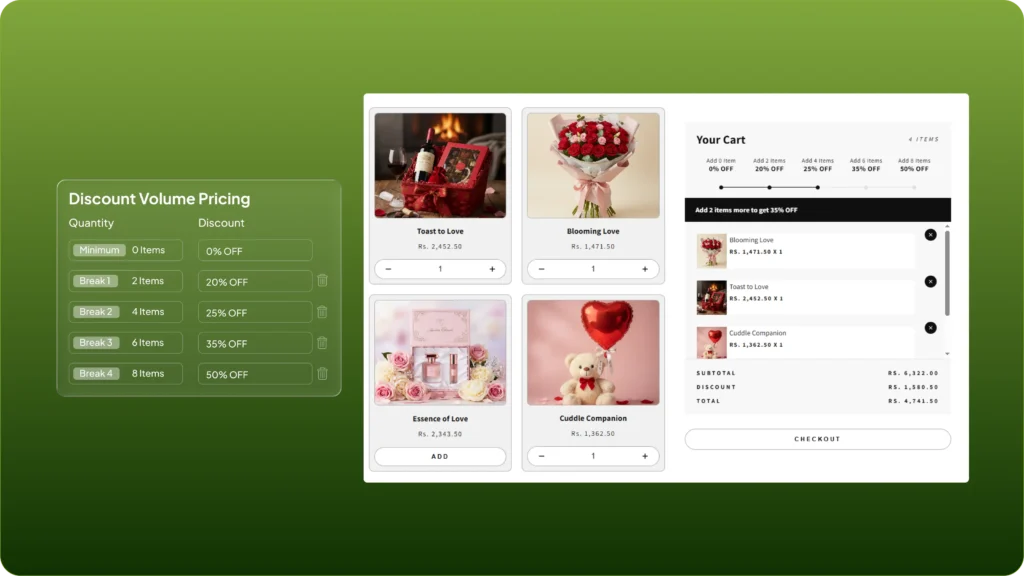
On standard Shopify plans, the checkout is intentionally restricted. You can adjust the look and make minor tweaks, but the core logic stays the same. That works fine when your business is simple. But as soon as your requirements become even slightly complex, those limitations start to show.
With Shopify Plus, that restriction is removed. You’re no longer just designing the checkout; you’re shaping how it behaves. Using Shopify’s extensibility features and tools like Functions, you can start controlling things that actually influence buying decisions in real time. For example, you can change how discounts are applied based on the type of customer, show different options for B2B buyers, or introduce logic that simply isn’t possible on standard plans.
This is also where things like custom fields, such as PO numbers, become possible without hacks. And more importantly, your shipping and payment options can adapt based on the situation instead of staying static.
2. Shopify Flow (Automation Without Manual Work)
As your store grows, one of the first things that starts breaking isn’t your website; it’s your operations.
You’re dealing with more orders, more customers, more edge cases… and suddenly, small manual tasks start piling up. Tagging customers, checking orders, managing inventory triggers; it all adds up faster than expected.
This is where Shopify Plus introduces something genuinely useful: Shopify Flow.
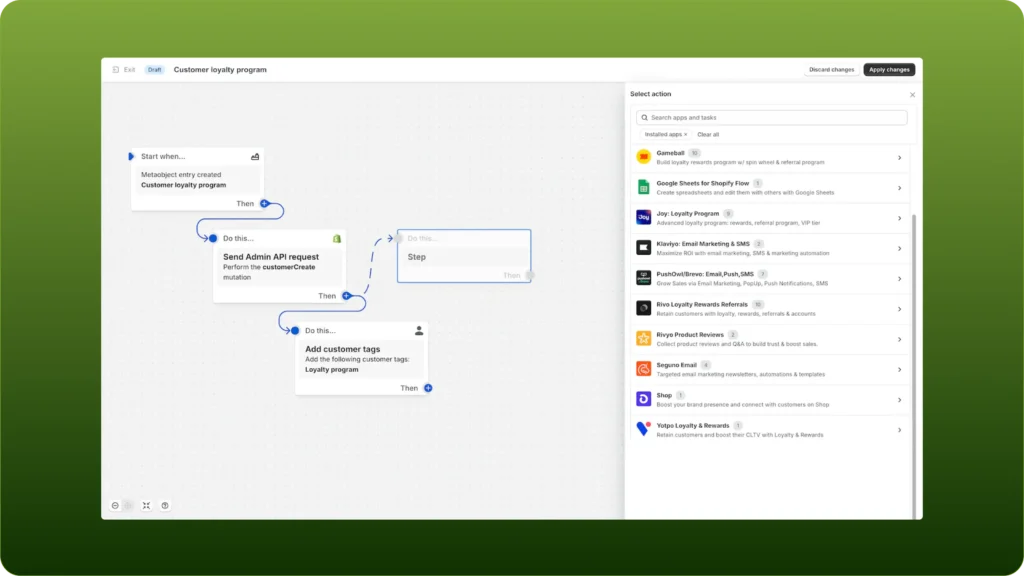
Instead of handling these tasks manually, Shopify Flow lets you automate how your store behaves behind the scenes. You can set up workflows that run automatically based on conditions you define, so your store starts responding to events in real time, without constant intervention.
For example, you can automatically tag high-value customers the moment they place an order, trigger internal alerts for large purchases, or flag suspicious orders before they become a problem. Even inventory-related actions can be structured in a way that reduces last-minute chaos.
But the real value here isn’t just saving time; it’s about consistency.
When you’re relying on manual processes, things get missed. Teams grow, operations get complex, and small errors start affecting customer experience. Automation removes that unpredictability.
With Shopify Flow, your store runs with a level of structure that’s hard to maintain manually. And as you scale, that reliability becomes just as important as growth itself, because smooth operations directly support a smoother buying experience.
3. Advanced B2B Capabilities
If B2B is even a small part of your business, this is where Shopify Plus starts to feel like a completely different platform.
On standard Shopify, running B2B usually means relying on multiple apps, workarounds, or even separate systems. It works, but it’s rarely smooth and as complexity increases, it becomes harder to manage.
Shopify Plus changes that by bringing B2B capabilities natively into the platform.
You can create company accounts where multiple users belong to the same business, each with their own roles. Pricing can be customized per customer or company, so you’re not forced into one-size-fits-all pricing. Payment terms like Net 15 or Net 30 can be built directly into the checkout experience, instead of being handled offline.
And one of the biggest advantages is that you can manage both wholesale (B2B) and direct-to-consumer (D2C) within the same store, without splitting your operations.
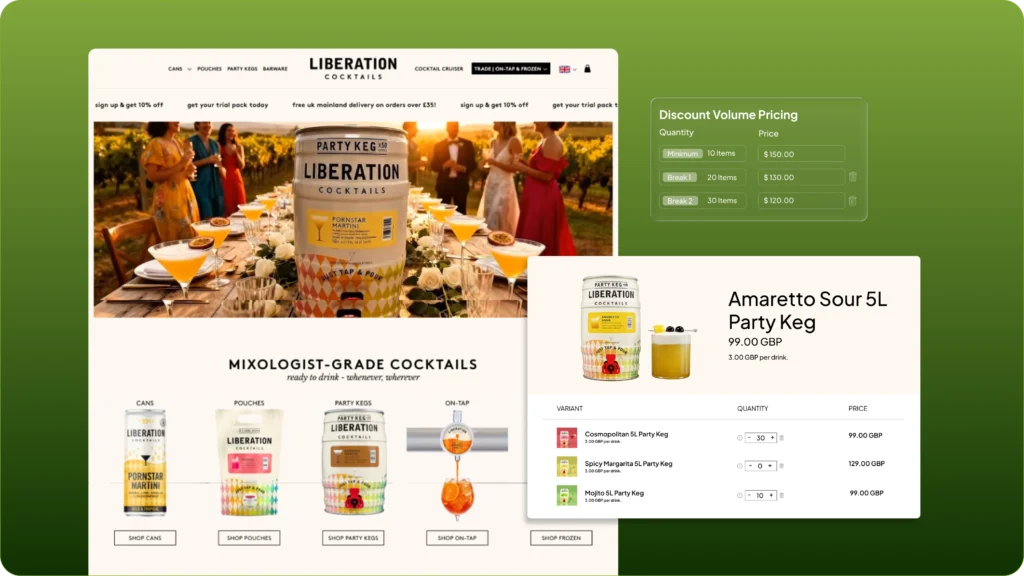
What makes this important isn’t just the features themselves, but the structure it creates.
B2B buyers don’t behave like regular customers. Their buying process is more structured, often involves approvals, and usually depends on pre-negotiated terms. If your store can’t support that natively, you end up creating friction without realizing it.
Shopify Plus allows you to align your store with how B2B customers actually buy, which not only simplifies operations on your side but also makes the experience feel more natural and efficient for them.
Know more about this from our recent Shopify B2B Blog.
4. Multiple Stores & International Expansion
As soon as you start thinking beyond a single market, things get complicated faster than expected.
Different countries mean different currencies, pricing strategies, customer expectations, and sometimes even completely different storefront experiences. Trying to manage all of that on a standard Shopify setup can quickly turn into a mix of workarounds.
This is where Shopify Plus gives you a much cleaner structure. It allows you to manage multiple stores in a more organized way, whether you’re expanding into new regions, running multiple brands, or creating separate storefronts for different customer segments. Instead of forcing everything into one setup, you can structure your stores based on how your business actually operates.
At the same time, you get better control over international selling. Things like local currencies, region-specific pricing, and storefront customization can be handled more intentionally, rather than patched together.
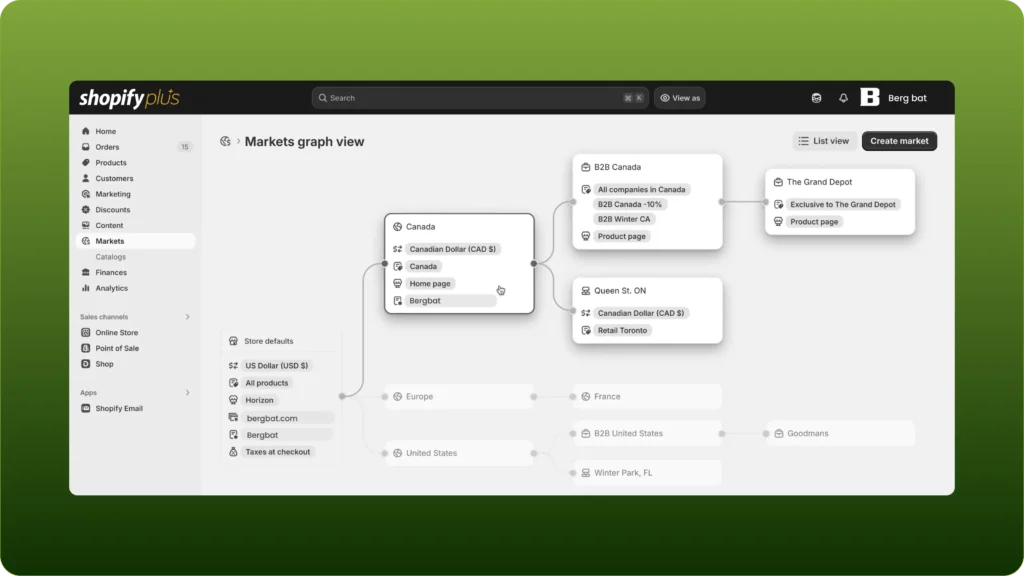
Global expansion isn’t just about reaching more customers; it’s about making the experience feel local to them. If your pricing feels off, your currency isn’t familiar, or the experience doesn’t match expectations, conversions drop.
Shopify Plus helps you avoid that by giving you the flexibility to adapt per market, while still keeping your operations manageable behind the scenes.
5. Higher API Limits & Performance at Scale
This is one of those things you don’t think about early on, but once your store starts growing, it becomes hard to ignore.
On standard Shopify plans, everything works smoothly… until you start pushing the limits. More traffic, more integrations, more real-time data and suddenly, performance and API restrictions begin to matter.
With Shopify Plus, those limits are significantly expanded. You get higher API capacity, which means your store can handle more requests from apps, integrations, and external systems without slowing down. This becomes especially important if you’re relying on ERPs, CRMs, or custom workflows that constantly interact with your store.
Performance under pressure is another key difference. During flash sales, product launches, or seasonal spikes, traffic doesn’t grow gradually; it comes in bursts. And in those moments, even a slight delay in loading, processing, or syncing can impact conversions directly.
This is where Shopify Plus is built to handle scale more reliably.
It’s not just about speed in normal conditions; it’s about stability when demand is at its highest. Because when your store is generating serious volume, you don’t just need it to work… you need it to hold up without breaking under pressure.
6. Script Editor & Shopify Functions (Advanced Custom Logic)
At some point, every growing store runs into this problem; you want your pricing, discounts, or shipping rules to behave in a very specific way… but the default setup just isn’t flexible enough.
On standard Shopify, you usually solve this by stacking apps. It works, but it also adds complexity, cost, and sometimes performance issues.
With Shopify Plus, you get a more direct way to handle this through Shopify Scripts (legacy) and Shopify Functions (the modern approach).
Instead of relying on third-party apps for every small requirement, you can build custom logic into how your store operates. This could be something like tiered pricing based on quantity, conditional discounts that apply only in specific scenarios, or shipping and payment rules that adapt based on the cart.
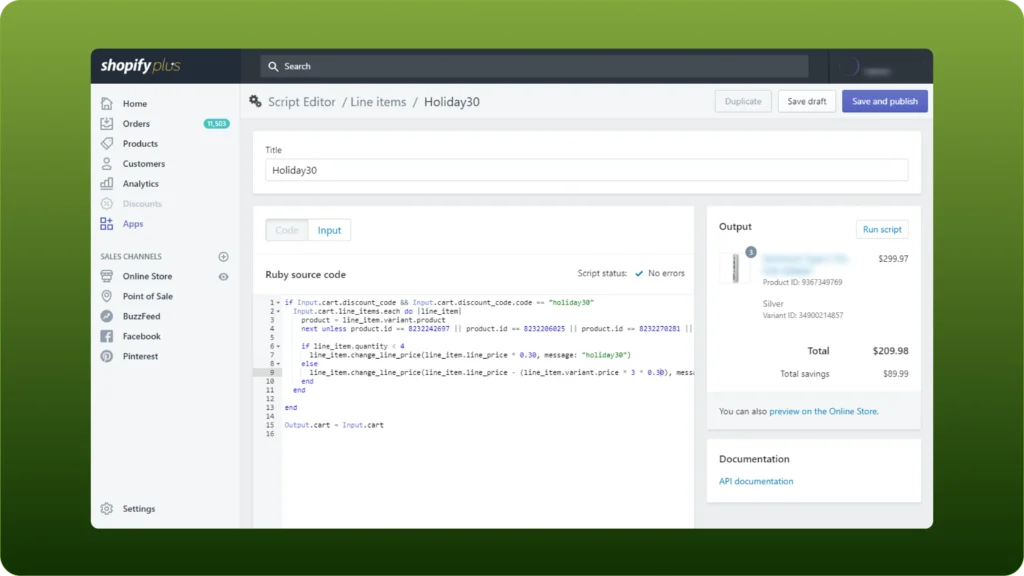
What makes this powerful isn’t just flexibility; it’s control.
When you depend heavily on apps, you’re often adjusting your business logic to fit the tool. With Scripts and Functions, it’s the opposite. Your store behaves exactly the way your business needs it to.
And over time, that difference adds up. Fewer workarounds, fewer dependencies, and a cleaner setup that’s easier to scale, especially when your pricing strategies or operations start getting more complex.
7. Dedicated Support & Account Management
Support is one of those things you don’t think about much, until something goes wrong.
On standard Shopify plans, support is there when you need it, but it’s still a shared system. Response times can vary, and you’re often explaining your setup from scratch each time.
With Shopify Plus, the experience is different. You get priority support, which means faster responses when issues come up. But more importantly, you’re assigned a dedicated Merchant Success Manager; someone who understands your business, your setup, and your goals over time.
That context makes a big difference because instead of reacting to problems in isolation, you have someone who can guide you proactively, whether it’s around scaling, optimizing workflows, or preparing for high-traffic events.
And when your store is generating significant revenue, this isn’t just a “nice to have” as even a short downtime or unresolved issue can directly impact sales. Having faster resolution and a more structured support system reduces that risk and gives you more confidence as you scale.
8. Better Control Over Frontend & Backend Experience
As your business evolves, you start realizing that it’s not just about having a good-looking store, it’s about how everything works together.
On standard Shopify plans, you can build a solid storefront, but there are still boundaries around how much you can customize the overall experience, both on the frontend and behind the scenes.
With Shopify Plus, those boundaries open up. You get more flexibility in shaping how your storefront behaves, how users move through it, and how your backend processes support that journey. This becomes especially important when your business doesn’t follow a typical ecommerce flow.
For example, if you have a unique buying process, need custom user journeys, or want tighter control over performance and interactions, Shopify Plus gives you the room to build that without constantly working around platform limitations.
And that’s the real shift here. Instead of adjusting your business to fit the platform, you can start shaping the platform around how your business actually operates, which becomes increasingly important as your requirements get more specific and more complex.
So, Is Shopify Plus Worth It?
Here’s the honest answer: it depends on where your business is right now.
Shopify Plus isn’t something you upgrade to just because it exists. It starts making sense when your store reaches a point where the limitations of standard Shopify begin to slow you down.
If you’re doing consistent high revenue, managing more complex operations like B2B or multiple storefronts, or finding yourself relying too much on apps and workarounds, that’s usually a sign. The same applies if your checkout, workflows, or integrations are starting to feel restrictive as you scale.
That’s where Shopify Plus shifts from being an “upgrade” to being an operational advantage.
But if you’re still in the early stages of growth, standard Shopify is more than capable. In fact, moving too early to Plus often means paying for flexibility you’re not fully using yet.
The key is timing.
Shopify Plus is worth it when your business complexity demands more control, not just more features.
The Real Difference
At a glance, the difference between Shopify and Shopify Plus can look like a list of extra features.
But that’s not really what sets them apart. The real difference is control.
Standard Shopify is designed to help you run a store efficiently within a proven structure. For most businesses, that structure works well and keeps things simple.
Shopify Plus, on the other hand, gives you the flexibility to move beyond that structure.
It allows you to shape how your store behaves from checkout logic to backend workflows to customer experiences, based on how your business actually operates. And as your operations become more complex, that level of control becomes less of a luxury and more of a necessity.
Thinking About Moving to Shopify Plus?
If you’re unsure whether Shopify Plus is the right step, that’s completely normal.
Upgrading too early often means you’re paying for flexibility you don’t fully need yet. But waiting too long can lead to workarounds, inefficiencies, and missed opportunities to improve your store’s buying experience.
The right time usually sits somewhere in between when your growth starts demanding more control, not just more features.
If you want a clear, practical evaluation based on your current setup and where you’re heading next, it’s worth having that conversation.
→ Let’s look at your store together and see if Shopify Plus actually makes sense for your business.